
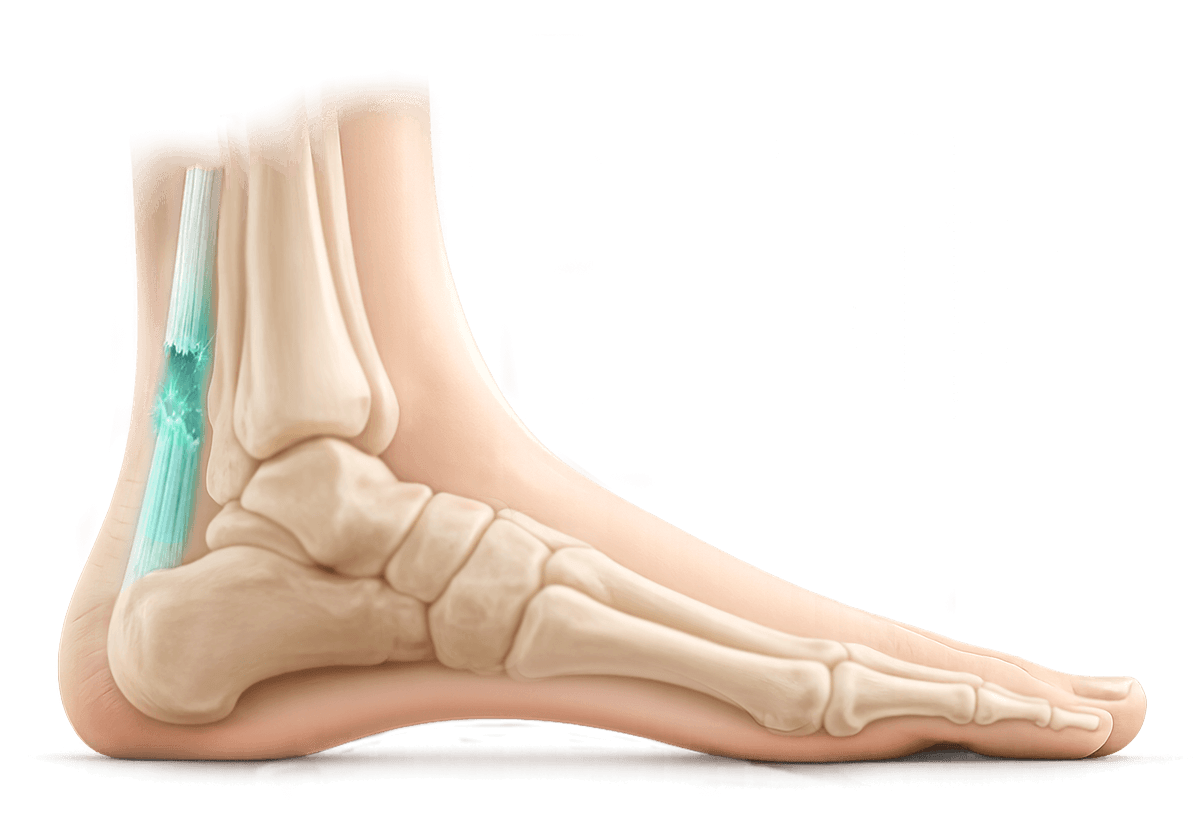
Rupture of the Achilles Tendon: What Is It?
An Achilles tendon rupture occurs when the Achilles tendon—the strong fibrous structure connecting the calf muscles to the heel bone—tears partially or completely. This tendon is essential for walking, running, jumping, and pushing off during movement. Achilles tendon ruptures are relatively common and usually happen suddenly.
This injury most commonly affects individuals who are not consistently conditioned for high levels of physical activity and then engage in sudden or intense movements, particularly during sports. It may also occur after a slip, misstep, or unexpected movement. In most cases, the rupture develops when the calf muscle contracts forcefully and unexpectedly, placing excessive stress on the tendon.
Many patients describe the sensation as feeling like they were suddenly struck or kicked in the back of the leg, despite no external contact. This is typically followed by immediate pain, swelling, weakness, and difficulty bearing weight. Although some individuals are still able to walk, the leg often feels unstable and weak, especially during push-off movements.
Why Is Surgery Often Recommended?
The primary objective of Achilles tendon surgery is to restore:
- Maximum tendon strength
- Normal push-off function of the foot
- Proper muscle-tendon balance
For the Achilles tendon to recover normal function, it must heal at the appropriate length and tension. If healing occurs with excessive lengthening or looseness, calf muscle strength can be permanently reduced, resulting in long-term limitations with walking, running, climbing stairs, and athletic activity.
Modern Minimally Invasive Repair
Historically, Achilles tendon repair required a large incision along the back of the leg, sometimes measuring 8 to 10 inches. These traditional open procedures carried a relatively high risk of wound healing complications and infection because the skin in this area has a limited blood supply. Due to these concerns, surgical treatment was previously avoided in some cases.
Today, modern minimally invasive techniques have significantly improved the safety and effectiveness of Achilles tendon repair.
Using a small “mini-incision” of approximately 2 centimeters, the tendon can now be repaired accurately and securely while minimizing disruption to surrounding tissues. This technique offers several important advantages:
- Smaller incision with reduced soft-tissue trauma
- Lower risk of wound healing complications and infection
- Reduced postoperative pain and faster recovery
- More predictable restoration of tendon strength and function
This minimally invasive approach enables precise tendon repair while substantially lowering the complication rates associated with older surgical methods.
Early Walking and Functional Recovery
One of the most important advances in modern Achilles rupture treatment is the introduction of early mobilization.
Following surgery, patients are typically allowed to walk using a removable protective boot. The design of this boot is essential, as it maintains the foot in a controlled position while allowing gradual and safe movement during the healing process. The permitted range of motion is carefully planned before surgery and progressively adjusted throughout recovery.
Older treatment approaches relied heavily on prolonged casting and strict avoidance of weight-bearing. Although widely used in the past, these methods frequently resulted in:
- Significant muscle weakness
- Calf muscle atrophy (muscle shrinkage)
- Joint stiffness and delayed rehabilitation
With modern treatment protocols:
- Casts are generally avoided
- Crutch use is minimized or sometimes unnecessary
- Walking begins earlier
- Physical therapy and rehabilitation exercises start soon after surgery
This contemporary approach helps improve strength, mobility, functional recovery, and overall patient outcomes.
Achilles Tendon Rupture Repair: Postoperative Recovery Timeline
Weeks 0–2
- Foot wrapped in a sterile bandage
- Ice, elevation, and pain medication as needed
- Begin full weight-bearing in a boot with heel wedges
- Keep the foot elevated as much as possible (“toes above the nose”)
- Avoid allowing the foot to remain hanging down for extended periods
- If traveling, move your toes frequently to encourage circulation and calf muscle activation
Week 2
- First postoperative follow-up visit
- Dressing change
- Plantarflexion (downward foot movement) is permitted
- Continue full weight-bearing in the boot with wedges
Weeks 2–6
If the incision is fully healed and dry:
- Swimming may begin at approximately 2–3 weeks
- Gentle stationary cycling may begin around 3 weeks, preferably while wearing the boot
- Gradual adjustment of the boot wedges
- By 6 weeks, the boot is transitioned into a neutral (flat) position
- Begin supervised physical therapy
- Increase activity progressively under the guidance of your therapist
Expected Outcome
With modern minimally invasive surgical techniques and early rehabilitation protocols, most patients:
- Recover excellent strength and overall function
- Return to normal daily activities
- Gradually resume sports and recreational activities
- Experience a safer and more efficient recovery compared to traditional treatment methods
Your Surgeon for Achilles Tendon Rupture Treatment on Long Island
Kristian Efremov, MD, PhD, is a fellowship-trained orthopedic foot and ankle surgeon. He evaluates and treats Achilles tendon ruptures for patients across Nassau and Suffolk County at NYU Langone Ambulatory Care East Meadow, 1530 Front Street, Suite 200, East Meadow, NY 11554.
This page covers minimally invasive Achilles tendon repair and an early-walking approach to recovery. The right option depends on your exam, imaging and goals.
Dr. Efremov completed his foot and ankle surgery fellowship at New England Baptist Hospital and is a Clinical Assistant Professor in the Department of Orthopedic Surgery at NYU Grossman Long Island School of Medicine.
To request an appointment, call (516) 324-7500 or read more about Dr. Efremov.
Medical Disclaimer. The information provided on this website is intended for general educational and informational purposes only and is not a substitute for professional medical advice, diagnosis, or treatment. Always seek the advice of a qualified healthcare professional regarding any medical condition, symptoms, or treatment options.