
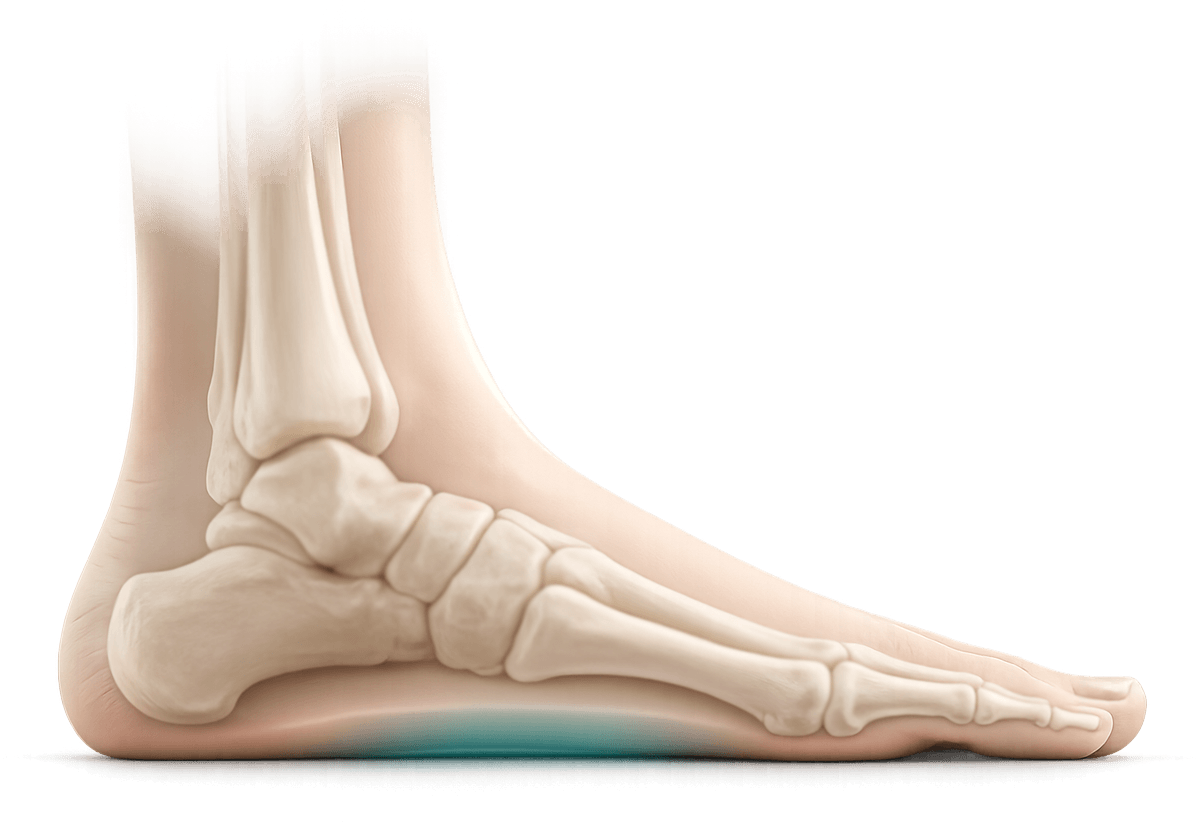
What is Flatfoot?
Flatfoot (also known as pes planus or adult acquired flatfoot deformity) is a condition in which the arch of the foot gradually lowers or collapses, causing most or all of the sole to come into contact with the ground while standing. Although many individuals with flat feet experience no symptoms, in some patients the condition becomes painful and progressive, potentially leading to significant functional limitations if not properly treated.
The condition is now more commonly described as Progressive Collapsing Foot Deformity (PCFD), a term that highlights its progressive nature rather than viewing it simply as a variation in foot shape.
What Causes Flatfoot?
Adult acquired flatfoot deformity most frequently occurs due to dysfunction or degeneration of the posterior tibial tendon—a key tendon located along the inner side of the ankle that supports the arch and stabilizes the foot.
When the posterior tibial tendon becomes weakened, stretched, or torn, it loses its ability to adequately support the arch, resulting in gradual flattening of the foot. Over time, this dysfunction may also affect other important stabilizing structures, including the spring ligament, supporting ligaments around the heel bone, and the plantar fascia.
Risk Factors
Several factors may increase the likelihood of developing flatfoot:
- Age: More commonly seen in middle-aged and older adults, especially women
- Obesity: Increased body weight places additional stress on the foot and ankle structures
- Diabetes: May negatively affect tendon quality and healing
- Hypertension: Can be associated with tendon degeneration
- Previous foot or ankle injuries
- Inflammatory conditions: Including rheumatoid arthritis
- Tight calf muscles: Reduced ankle flexibility can increase strain on the arch
What Are the Symptoms?
Flatfoot commonly produces symptoms that develop progressively over time:
Pain and Discomfort
- Pain along the inner side of the foot and ankle, particularly over the course of the posterior tibial tendon
- Pain on the outer side of the ankle (sinus tarsi region)
- Pain that increases with activity, especially prolonged walking or standing
- Swelling along the inner aspect of the ankle
Visible Changes
- Loss or flattening of the arch while standing
- Outward tilting of the heel bone (“too many toes” sign visible from behind)
- Outward rotation of the front part of the foot
- Difficulty standing on tiptoes or lifting the heel on the affected side
Functional Problems
- Difficulty walking, particularly on uneven surfaces
- Fatigue of the foot and lower leg
- Reduced balance and stability
- Abnormal shoe wear patterns
- Difficulty wearing standard footwear comfortably
Recent studies suggest that peritalar subluxation—where the bones surrounding the ankle shift from their normal alignment—is a major factor contributing to symptoms in painful flatfoot, distinguishing it from painless flat feet.
How is Flatfoot Diagnosed?
Your foot and ankle surgeon will diagnose flatfoot through:
Physical Examination
- Assessment of foot alignment during standing and walking
- Evaluation of your ability to rise onto your toes (single-leg heel raise test)
- Examination of foot flexibility
- Assessment of the strength and condition of the posterior tibial tendon
- Evaluation of ankle motion and calf muscle tightness
Imaging Studies
- Weight-bearing X-rays: Used to assess bone alignment and the severity of arch collapse
- MRI: May help identify tendon degeneration and ligament injury
- Advanced imaging: Weight-bearing CT scans can provide detailed three-dimensional evaluation of bone alignment and joint subluxation
Treatment Options
Management typically begins with non-surgical care, including supportive footwear, orthotics, targeted therapy, and activity modification. When symptoms persist or the deformity progresses, surgical treatment may be appropriate.
Surgical treatment is designed to restore alignment and function. This may involve heel realignment, selective soft-tissue procedures, and reconstruction of the arch. In advanced cases, joint fusion may be required.
Recovery
Recovery depends on the procedure performed. It generally includes an initial period of non-weight-bearing, followed by a graduated return to walking in a protective boot, and transition to regular footwear over subsequent months, with continued improvement thereafter.
Your Surgeon for Flatfoot Reconstruction on Long Island
Kristian Efremov, MD, PhD, is a fellowship-trained orthopedic foot and ankle surgeon. He evaluates and treats flatfoot for patients across Nassau and Suffolk County at NYU Langone Ambulatory Care East Meadow, 1530 Front Street, Suite 200, East Meadow, NY 11554.
Options covered on this page range from non-surgical care to reconstructive surgery to restore the arch. The right option depends on your exam, imaging and goals.
Dr. Efremov completed his foot and ankle surgery fellowship at New England Baptist Hospital and is a Clinical Assistant Professor in the Department of Orthopedic Surgery at NYU Grossman Long Island School of Medicine.
To request an appointment, call (516) 324-7500 or read more about Dr. Efremov.
Medical Disclaimer. The information provided on this website is intended for general educational and informational purposes only and is not a substitute for professional medical advice, diagnosis, or treatment. Always seek the advice of a qualified healthcare professional regarding any medical condition, symptoms, or treatment options.