
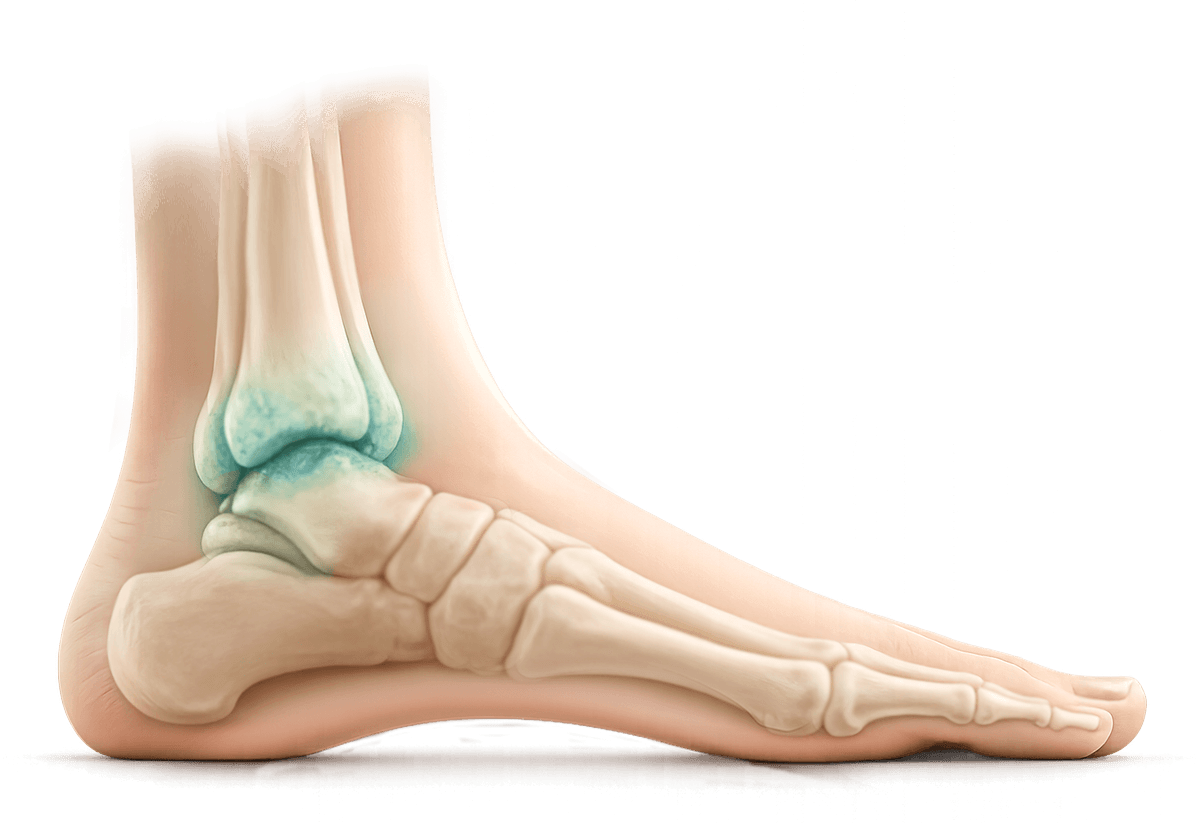
What Is Ankle Arthritis?
Ankle arthritis, also known as ankle osteoarthritis, occurs when the cartilage within the ankle joint gradually wears down. This can result in pain, stiffness, swelling, and difficulty walking. Unlike arthritis of the hip or knee, which commonly develops from age-related wear over time, ankle arthritis is most often linked to a previous injury.
In fact, approximately 75% to 80% of ankle arthritis cases develop after an ankle fracture or a significant ankle sprain. Common symptoms include pain that becomes worse with activity, swelling around the ankle joint, morning stiffness, difficulty standing or walking for extended periods, and a feeling of weakness or instability in the ankle.
What Causes Ankle Arthritis?
The leading cause of ankle arthritis is previous injury to the ankle, including fractures, severe sprains, or ligament damage. This is referred to as post-traumatic arthritis and accounts for nearly 78% of cases.
Other causes include inflammatory conditions such as rheumatoid arthritis, primary osteoarthritis without a clear underlying cause, as well as risk factors such as increasing age, excess body weight, and a history of repeated ankle injuries.
Non-Surgical Treatment Options
Before surgery is considered, several non-surgical treatments are usually recommended. These treatments are important first-line options and can provide meaningful symptom relief for many patients.
Activity Modification and Weight Management
Limiting activities that aggravate symptoms and maintaining a healthy body weight can reduce stress on the ankle joint. Research shows that higher body weight is associated with worsening ankle arthritis symptoms.
Physical Therapy and Exercise
Stretching and strengthening exercises can help improve ankle stability, mobility, and overall function. Physical therapy also supports muscle strength around the ankle and helps maintain range of motion.
Medications
- Over-the-counter pain medications such as acetaminophen or ibuprofen
- Topical anti-inflammatory creams or gels applied directly to the ankle
- Prescription oral anti-inflammatory medications recommended by your physician
Orthotics and Bracing
Custom orthotics, shoe inserts, and ankle braces can improve support, reduce stress on the joint, and decrease pain while walking.
Injections
- Corticosteroid injections: These injections may provide temporary pain relief, although repeated injections may have limitations and should be carefully discussed with your physician.
- Platelet-rich plasma (PRP): PRP is an emerging regenerative treatment that uses components of your own blood to potentially support healing and reduce inflammation.
When Surgery May Be Needed
If non-surgical treatments fail to provide sufficient relief after several months and ankle arthritis continues to significantly affect daily activities, surgery may be recommended. The most appropriate procedure depends on factors such as age, activity level, severity of arthritis, ankle alignment, and overall health.
Surgical Treatment Options
Ankle Fusion (Ankle Arthrodesis)
Ankle fusion is a well-established surgical procedure designed to eliminate pain by permanently joining the bones of the ankle joint. Although ankle motion is no longer preserved, the procedure provides excellent pain relief and long-term stability.
Minimally Invasive Approach
Modern ankle fusion procedures can often be performed using minimally invasive techniques rather than traditional open surgery. This approach offers several important benefits.
- Reduced postoperative pain
- Significantly lower infection risk
- Faster bone healing
- Earlier weight bearing
Total Ankle Replacement with Custom 3D Printed Instrumentation
Total ankle replacement preserves ankle motion while replacing damaged joint surfaces with artificial implants. Recent advances in patient-specific 3D printed instrumentation have improved the accuracy and success of this procedure.
Prior to surgery, a CT scan of the ankle is obtained to create a detailed three-dimensional model of the patient’s anatomy. Using this model, customized surgical guides are produced with 3D printing technology to help achieve highly accurate implant positioning.
Advantages of Custom 3D Printed Instrumentation
- Superior surgical precision
- Shorter surgery time
- Better functional outcomes
- Lower complication rates
- Faster recovery
- Excellent long-term implant survival
Ankle Distraction Arthroplasty
Ankle distraction arthroplasty is a joint-preserving procedure that may serve as an alternative to ankle fusion or replacement, especially in younger and more active patients who wish to delay more extensive surgery.
An external frame is attached to the leg and foot using small pins placed through the bone. The device gently separates the ankle joint to reduce pressure on the damaged cartilage while preserving the natural joint.
Key Advantages
- Joint preservation
- Full weight bearing allowed during treatment
- Excellent pain relief
- Long-lasting results
- Potential to delay or avoid fusion or replacement
Who Benefits Most
This procedure is generally best suited for younger, active patients who maintain reasonable ankle motion, have a healthy body weight, and are willing to commit to the treatment period and rehabilitation exercises.
Choosing the Right Treatment for You
The most appropriate treatment depends on each patient’s individual condition and goals. Factors your surgeon will consider include age, activity level, severity of arthritis, ankle alignment, overall health, previous ankle surgery, and personal goals.
Specific Post Operative Recovery for Ankle Fusion
Week 0–2
- The foot is placed in a bandage and splint immediately after surgery
- Keep the leg elevated and take pain medication as directed
- Crutches, walker, wheelchair, or knee scooter are required
- The dressing and splint should remain dry and unchanged
Week 2–6
- Patients are transitioned into a surgical boot
- No weight bearing is allowed for approximately six weeks
Week 6
- Full weight bearing in the boot is usually permitted
Week 12
- Transition to regular sneakers
- Gradual return to activities begins
Specific Post Operative Recovery for Ankle Replacement
Week 0–2
- The foot is wrapped in a bandage and splint
- Keep the dressing dry and avoid changing the splint
- Crutches or mobility assistance are required
Week 2–6
- X-rays are obtained and the splint is removed
- A removable walking boot is provided
- Gentle movement exercises are started
- Stationary bike exercise may begin around four weeks
Weeks 6–8
- Transition into regular sneakers
- Physical therapy is started
- Activity levels are progressively increased
General Questions About Ankle Replacement Recovery
When can I start exercising after ankle surgery?
Gentle exercises and ankle range-of-motion activities are typically encouraged approximately two to three weeks after surgery.
How soon can I drive a vehicle again?
If surgery was performed on the left ankle, driving an automatic vehicle may be possible after approximately two weeks. For surgery on the right ankle, driving is usually allowed after four to six weeks.
Do I have to do physical therapy?
Physical therapy is an important part of recovery after ankle replacement surgery and helps restore strength, mobility, balance, and function.
How long can I expect to have swelling?
Moderate swelling of the ankle and leg may continue for approximately six to nine months following surgery.
Your Surgeon for Ankle Arthritis Treatment on Long Island
Kristian Efremov, MD, PhD, is a fellowship-trained orthopedic foot and ankle surgeon. He evaluates and treats ankle arthritis for patients across Nassau and Suffolk County at NYU Langone Ambulatory Care East Meadow, 1530 Front Street, Suite 200, East Meadow, NY 11554.
Options covered on this page range from activity changes, bracing and injections to ankle fusion, ankle distraction arthroplasty and total ankle replacement with custom 3D-printed instrumentation. The right option depends on your exam, imaging and goals.
Dr. Efremov completed his foot and ankle surgery fellowship at New England Baptist Hospital and is a Clinical Assistant Professor in the Department of Orthopedic Surgery at NYU Grossman Long Island School of Medicine. His research focuses on minimally invasive surgery and ankle replacement.
To request an appointment, call (516) 324-7500 or read more about Dr. Efremov.
Medical Disclaimer. The information provided on this website is intended for general educational and informational purposes only and is not a substitute for professional medical advice, diagnosis, or treatment. Always seek the advice of a qualified healthcare professional regarding any medical condition, symptoms, or treatment options.